The Planning Paradox: When Cutting Scope Costs More Than Building It
There's an uncomfortable math problem hiding inside most planning meetings right now, and almost nobody is talking about it.
The Old Math Made Sense
Not long ago, engineering time was the expensive thing. A feature that took a developer two weeks carried real cost — salary, opportunity cost, context switching, QA, the whole chain. So teams invested heavily in planning. Hours in rooms debating what to cut. Careful MVP definitions. Protecting engineer time was the rational move because engineer time was the bottleneck.
The New Math Doesn't
AI-assisted development has compressed implementation time dramatically. But most organizations haven't updated their planning rituals to match. The meetings are the same length. The scope debates are the same intensity. The impulse to "protect engineering time" is still the default posture — even when the time being protected has shrunk.
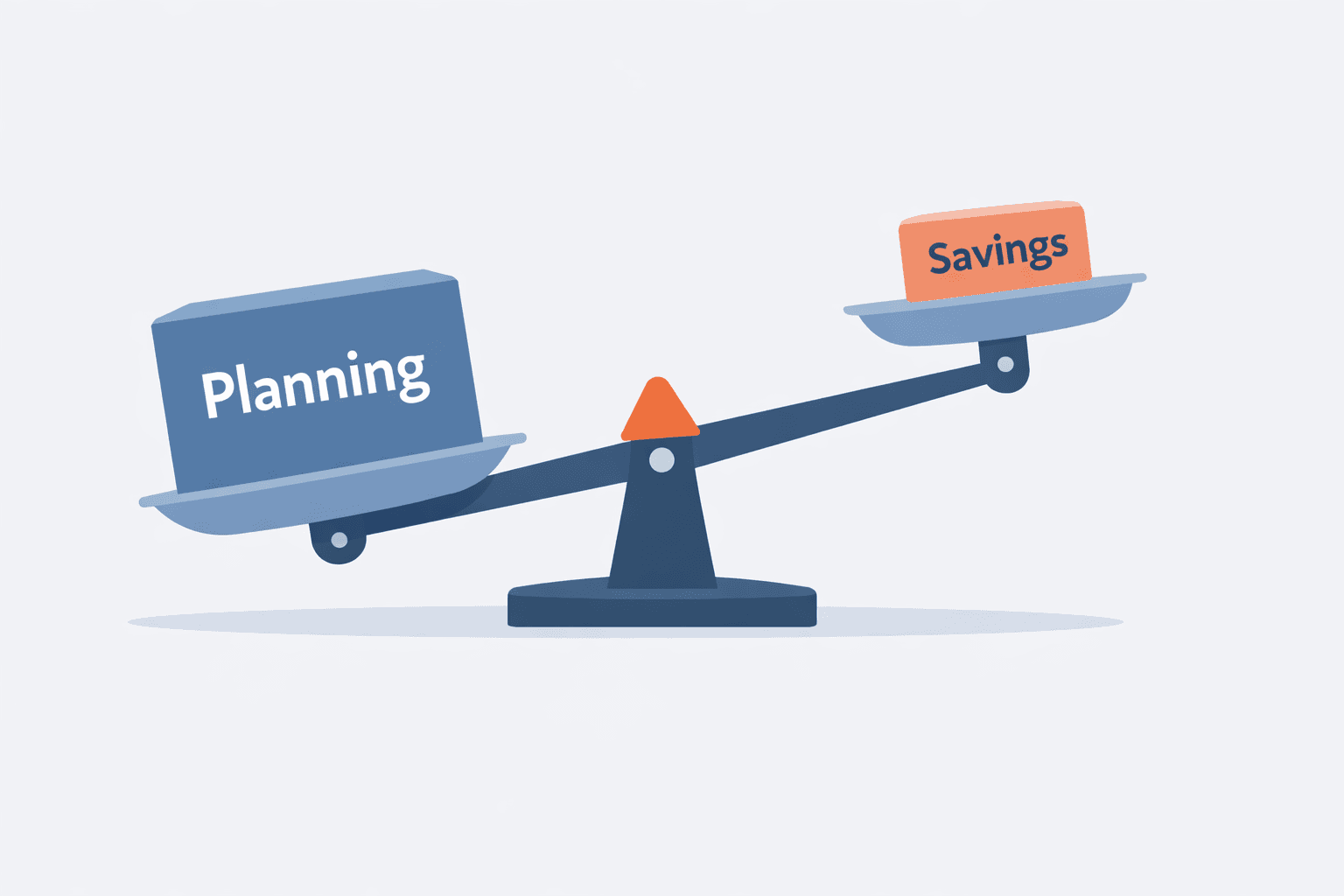
Here's what that looks like: A team spends 8 points of effort in planning sessions carefully identifying what to cut from a 20-point project. After all the deliberation, the revised estimate lands at 18. The planning cost more than the savings it produced.
The Inversion Nobody's Talking About
This isn't just inefficiency — it's an inversion. The most expensive part of many product cycles is no longer the engineer writing code. It's the collective human time spent deciding what the engineer should write. Senior engineers, product managers, designers, stakeholders — all debating whether Feature X makes the MVP cut, when building Feature X has become near-trivial.
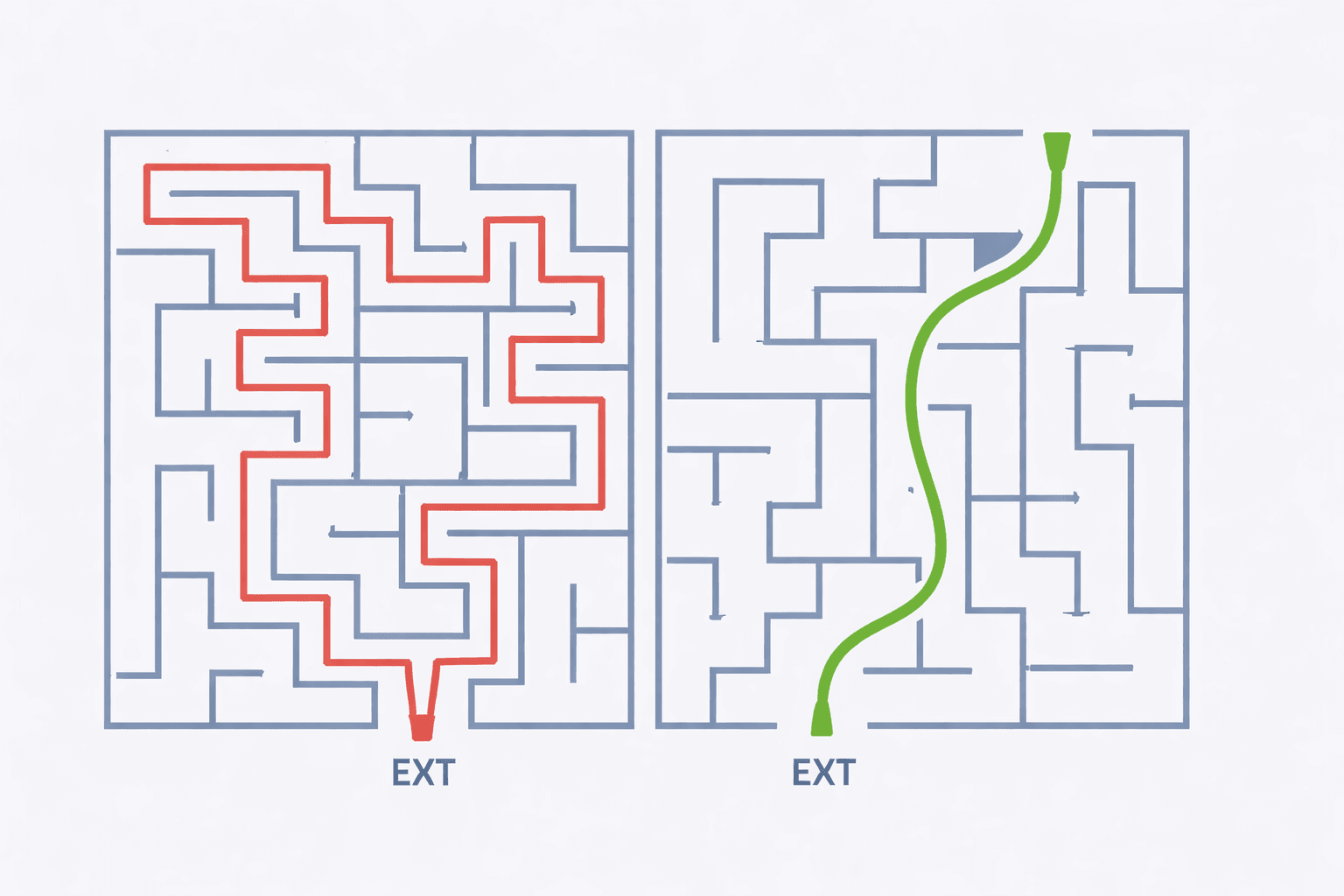
And the cost isn't just the meeting hours. Every "simplification" directive from the planning layer carries its own implementation weight. When a manager says "just do it the simple way," they often don't have visibility into what's actually simple for the person building it. The prescribed shortcut can add complexity rather than remove it — a different database call pattern, an exception to the existing architecture, a special case that now has to be maintained.
Here's the uncomfortable part: the person who knows what's simplest is the person working with the agents, day in and day out. They know what the codebase looks like right now. They know what the AI handles cleanly and where it fights you. They know which "shortcut" is actually a detour. If you've been managing for more than a year and you don't write code anymore, you might not have that model. Not because you're not smart — because the ground has shifted under you, and the only way to know the new terrain is to walk it.
The better question isn't "do this, it's simplest." It's "what's going to be simplest for you?" — asked to the person who actually knows.
When Building Is Cheap, the Questions Change
If planning isn't about minimizing implementation cost anymore, what's it for? The purpose shifts. Instead of "can we afford to build this?" the question becomes "will we regret building this?" That's a fundamentally different conversation — shorter, higher-signal, focused on direction rather than effort budgets.
This also changes how you think about architectural principles like DRY. When implementation was expensive, you thought hard about reuse upfront because you couldn't afford to build it twice. Now, the calculus shifts. Maybe you build the feature, learn from how it actually gets used, and then refactor for reuse — once you know what the real abstraction should be, not what you guessed it would be in a planning meeting. The refactor isn't gone, but it moves to a place where you have real information instead of speculation.
More decisions get shunted to implementation. Not because planning doesn't matter, but because the person closest to the code has the most accurate model of what's actually easy and what's actually hard. The role of leadership becomes setting direction and guardrails — "will we regret this?" — not dictating method.
Err Toward Action
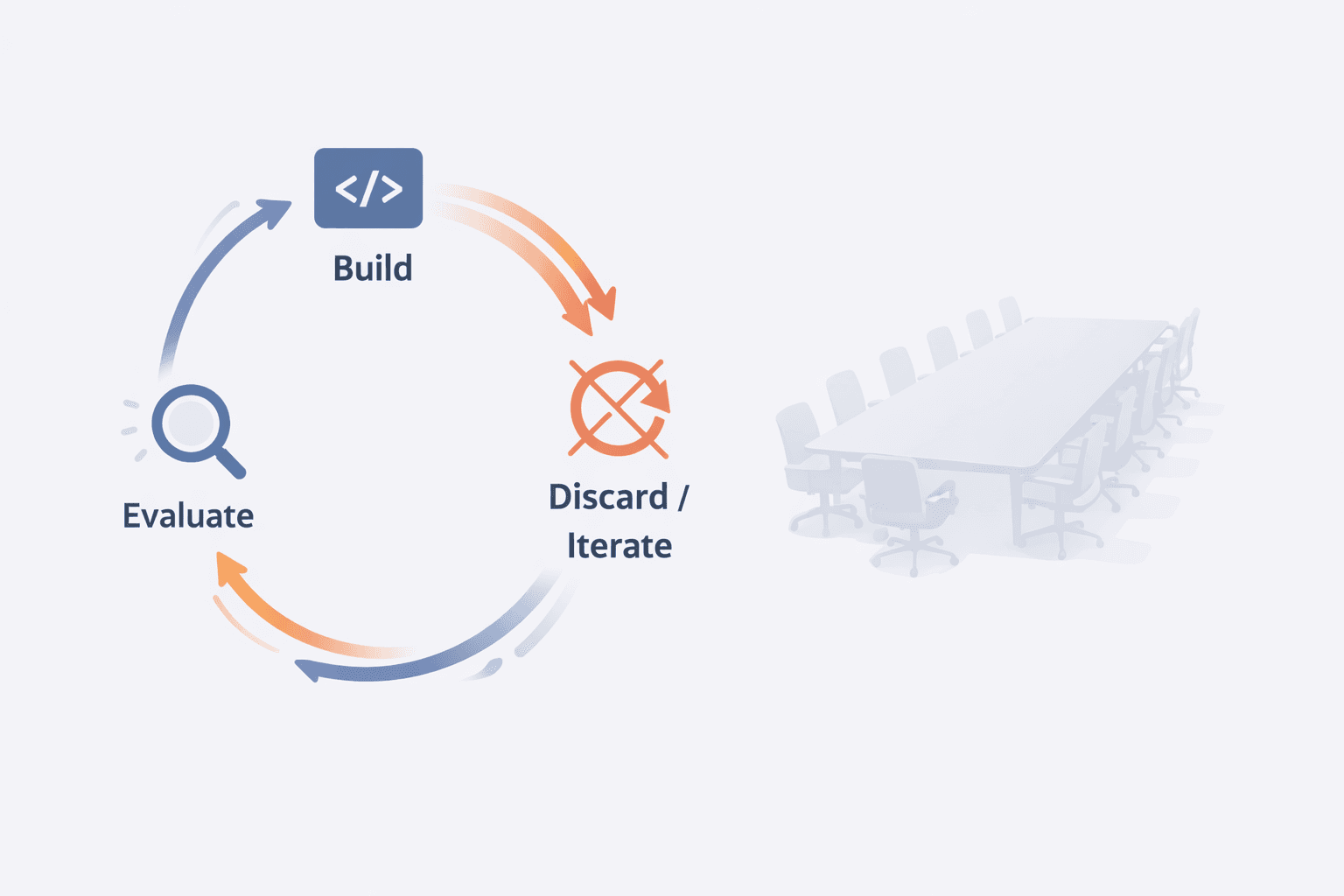
If building is cheap and planning is expensive, the optimal strategy often flips: build the thing, evaluate it, throw it away if it's wrong. Prototyping becomes cheaper than debating.
This is uncomfortable for organizations built around careful deliberation. But the math is the math. The teams that figure this out first will move at a pace that makes scope-cutting committees look like they're standing still.